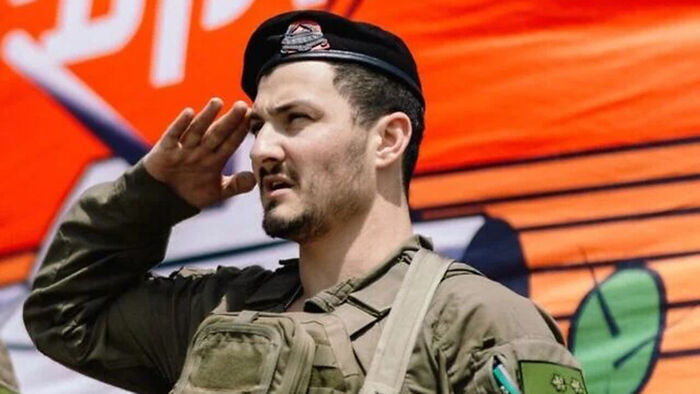
▲ Lieutenant Colonel Dor Gedalia Ben Simon, an Israeli commander killed in a Hezbollah attack
Renewed armed clashes between the Israeli military and the pro-Iranian militant group Hezbollah are raising concerns about the potential negative impact on the ceasefire agreement and subsequent negotiations between the United States and Iran.
In particular, the significant casualties suffered by Israeli troops stationed in southern Lebanon due to the Hezbollah attack are expected to trigger a large-scale retaliatory strike from Israel.
The Israel Defense Forces (IDF) announced on June 19 that one tank battalion commander and three soldiers were killed in southern Lebanon following a Hezbollah attack.
The fallen soldiers include Lieutenant Colonel Dor Gedalia Ben Simon, commander of the 52nd Battalion of the 401st Armored Brigade, along with three crew members who were in the same tank.
The IDF stated, "It is assessed that a projectile, believed to be a drone or an anti-tank missile fired by Hezbollah, directly hit Lt. Col. Ben Simon's tank in the village of Kfar Tebnit in southern Lebanon."
The IDF further reported that several hours later, a suicide drone attack by Hezbollah in the same village left one reserve officer from a special forces unit seriously injured, while four others, including a reserve non-commissioned officer and soldiers, sustained minor injuries.
The Israeli military also launched intense airstrikes on various Hezbollah facilities in southern Lebanon starting on the night of June 18, the day after the signing of the U.S.-Iran memorandum of understanding on ending the war.
According to Lebanon's state-run National News Agency (NNA), at least 16 people were killed in the Israeli airstrikes.
The IDF announced on June 19 that it had also struck Hezbollah infrastructure in the Bekaa Valley of eastern Lebanon.
The Israeli military claimed that its airstrikes were a response to repeated ceasefire violations by the Iranian-backed Hezbollah.
As the Hezbollah attack has caused significant casualties for the Israeli military, the likelihood of a major retaliatory operation has increased, which could, in turn, affect the ceasefire agreement and follow-up negotiations between the U.S. and Iran.
The armed conflict between Israel and Hezbollah remains the greatest risk factor that could negatively influence the progress of the ceasefire agreement and subsequent negotiations between the U.S. and Iran.
Iran is citing the "guarantee of Lebanon's territorial integrity and sovereignty" clause in the memorandum of understanding to demand the withdrawal of Israeli troops from southern Lebanon, arguing that Israel's refusal to withdraw constitutes a nullification of the agreement.
Conversely, Israel maintains that it will keep its troops stationed in southern Lebanon and continue operations until the security threat posed by Hezbollah is completely eliminated.
In fact, amid the clashes between Israel and Hezbollah, the first working-level talks between the U.S. and Iran, which were scheduled to be held in Switzerland on June 19, were ultimately canceled.
Meanwhile, Itamar Ben-Gvir, the Minister of National Security and a prominent far-right figure in Israel's ruling coalition, stated immediately after the announcement of the soldiers' deaths, "With all due respect to the United States, Israel must clearly show the entire world that the blood of our soldiers and the security of our citizens can never be a subject for negotiation," adding, "All of Lebanon should burn."
(Photo: Provided by IDF, Yonhap News)
※ Please note: This article was translated by AI and may contain errors.